






Massage Gun Market Size in 2026: Why Industry Estimates Vary and Where the Opportunity Lies
When wellness brands and product managers research the global massage gun market in 2026, the first thing they notice is that reputable research houses report different headline figures. Depending on which report you consult, the global market is estimated at USD 529.4 million in 2026 by Grand View Research, projected at USD 793.08 million in 2026 by 360iResearch (via Research and Markets), or valued at USD 1.48 billion in 2024 by TechSci Research (via Research and Markets), with forecasts reaching USD 2.45 billion by 2030.
For B2B buyers and commercial decision-makers, seeing different dollar totals can initially look confusing. However, looking beneath the top-line numbers reveals a decisive conclusion: every major market research provider confirms that the percussive massage gun category is expanding at a steady, multi-year compound annual growth rate of 7.25% to 10.0%. Rather than fading as a short-lived fitness novelty, the massage gun has cemented itself as an indispensable hardware staple in global personal wellness, athletic recovery, and daily home relaxation.
Key Takeaways
- A Confirmed Growth Category: Independent market studies project steady compound annual growth rates (CAGR) between 7.25% and 10.0% through 2030–2033, demonstrating durable global demand across consumer and professional segments.
- Understanding Baseline Differences: Market valuations vary from USD 529.4 million to USD 1.48 billion because research providers apply different product boundaries (dedicated percussive guns vs. broader handheld massagers), pricing levels (wholesale factory-gate vs. retail sell-through), and baseline years.
- The Sweet Spot in Sourcing: Segment data from Grand View Research highlights that personal/home users (59.8%), online distribution (68.1%), mainstream price tiers (44.3%), and North America (37.0%) drive the bulk of category revenue.
- The Path to Premium Margins: In a mature e-commerce landscape where look-alike commodity guns face price pressure, product differentiation centers on multi-modal recovery—such as combining high-frequency percussion with active hot and cold temperature therapy.
Published Massage Gun Market Size Estimates Compared
To evaluate the category objectively, commercial teams should examine how leading research firms structure their forecasts:
|
Research Provider (Distributor) |
Base / Estimate Year & Value |
Forecast Horizon & Projected Value |
Projected CAGR |
Publication / Update Timing |
|---|---|---|---|---|
|
2025: USD 491.5M / 2026 Est.: USD 529.4M |
2033: USD 921.4M |
8.2% (2026–2033) |
Published June 2026; Updated Sept 2026 |
|
|
TechSci Research (via Research and Markets) |
2024: USD 1.48B |
2030F: USD 2.45B |
8.8% (2025–2030) |
Published Sept 2025 |
|
360iResearch (via Research and Markets) |
2026 Proj.: USD 793.08M |
2032: USD 1.21B |
7.25% (2026–2032) |
Published Sept 2026 |
|
Technavio (via Research and Markets — Supplementary Growth Context) |
Starting absolute baseline not publicly disclosed |
Incremental growth of +USD 396.47M (2025–2030) |
10.0% (2025–2030) |
2026–2030 Forecast Series |
Note: Research and Markets distributes the TechSci Research, 360iResearch, and Technavio publications. Technavio’s public preview highlights incremental expansion (+USD 396.47 million) and a 10.0% CAGR, serving as additional directional validation.

Why Industry Estimates Diverge: A Guide for Sourcing Teams
Seeing a 2026 estimate of USD 529.4 million alongside valuations exceeding USD 1.48 billion is not a sign of unreliable data—it reflects how market researchers define their analytical parameters:
1. Category Scope and Hardware Taxonomy
Narrower models focus exclusively on dedicated pistol-grip percussive guns. Broader studies incorporate general handheld vibration appliances, commercial clinical units, and replacement attachment ecosystems.
2. Valuation Level Across the Supply Chain
Some market models calculate category size at manufacturer/ex-factory wholesale value, while others evaluate total consumer spend at retail sell-through prices.
3. Different Base Years and Forecast Windows
Each study anchors its projections to a different starting year and horizon: TechSci Research anchors from a 2024 base through 2030, 360iResearch tracks 2026 through 2032, and Grand View Research models from a 2025 base (USD 491.5 million) and 2026 estimate (USD 529.4 million) through 2033.
Rather than averaging these numbers into an artificial figure, experienced B2B buyers treat these reports as complementary brackets that clearly demonstrate strong, continuous expansion.
Where the Reports Agree: Growth Direction and Market Structure
Behind the baseline variations, the market data reveals four clear structural trends that guide successful product planning:
Steady 7.25% to 10.0% Annual Compound Growth
All four research providers project robust compound annual growth rates: 7.25% (360iResearch), 8.2% (Grand View Research), 8.8% (TechSci Research), and 10.0% (Technavio). This consistent trajectory proves that massage guns have transitioned from an early viral trend into an established, resilient consumer wellness category.
Clear Segmentation Benchmarks from Grand View Research
Detailed segment data from Grand View Research's market analysis shows where actual purchasing power is concentrated:
- Personal and Home Users Lead Demand (59.8% share): Everyday consumers seeking relief from desk stiffness, active lifestyle soreness, and general muscle fatigue generate nearly three-fifths of category revenue, significantly outpacing commercial gym and clinical clinic purchases.
- Online Channels Drive Global Distribution (68.1% share): E-commerce platforms and digital brand storefronts represent more than two-thirds of worldwide sales.
- The Mainstream Tier Captures the Largest Revenue (44.3% share): Well-built, mainstream-priced products hold the single largest market share, outperforming both fragile ultra-budget gadgets and high-priced professional devices.
- North America Anchors Global Demand (37.0% share): North America remains the largest single market, while Europe, Asia-Pacific, and emerging regions account for the remaining 63.0% of expanding global demand.
What These Market Signals Mean for B2B Brands and Sourcing Teams
For wellness brands, private-label distributors, and retail category managers, market research is only valuable when translated into practical commercial execution. The current data highlights three vital strategic imperatives:
- Category Expansion Alone Will Not Carry Commodity SKUs: While a 7.25%–10% CAGR confirms strong underlying demand, the dominance of online sales (68.1%) means consumers can compare basic speed settings, battery sizes, and housing designs side by side. Launching another generic, look-alike public-mold massage gun inevitably leads to price wars and compressed margins.
- Targeting the Home-Use and Mainstream Sweet Spot: With 59.8% of revenue coming from personal/home users and 44.3% in the mainstream tier, product development should focus on what daily users value most: comfortable ergonomics, quiet motor operation (<45 dB), lightweight handling, long battery endurance, and intuitive controls—rather than unnecessarily harsh stall force designed only for heavy athletes.
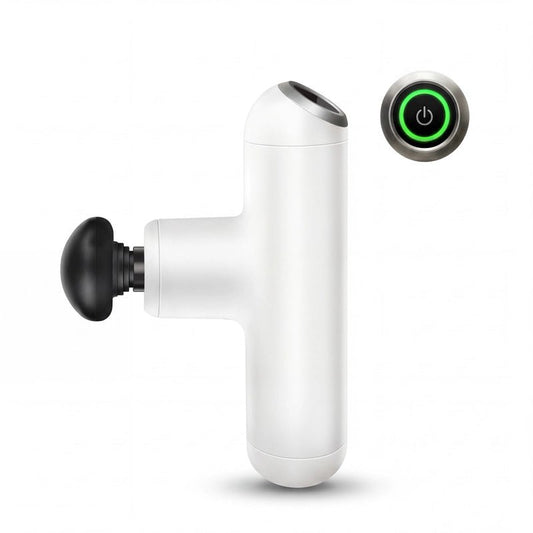
- Multi-Modal Innovation as the Real Margin Driver: To stand out in competitive digital and retail channels, forward-thinking brands are upgrading from single-action percussion to multi-modal recovery devices. Integrating active thermal therapy alongside percussion—such as the HXR-B360
Hot And Cold Fascia Gun with Extended Handle
—enables brands to command higher price points, capture broader consumer wellness demographics, and build defensible product lines.

Turning Market Context into Product Strategy
The data is clear: whether measured at USD 529.4 million (Grand View Research) or USD 1.48 billion (TechSci Research), global demand for percussive massage hardware is growing steadily through 2030–2033. For brands and distributors, the central question is no longer whether to enter the category, but how to enter it with a differentiated product and a reliable manufacturing partner.
At ECOZY, we help global wellness brands turn market opportunities into profitable, high-performing product lines:
- Comprehensive OEM & ODM Engineering: Backed by years of specialized manufacturing experience in personal recovery devices, ECOZY provides end-to-end support—from industrial design (ID) and structural prototyping to precision mold tooling and PCBA electronics development.
- Market-Proven Multi-Modal Platforms: Our flagship HXR-B330 Massage Gun with Heat and Cold demonstrates this engineering depth, integrating 3-level heating (40°C–50°C), 3-level cooling (20°C–10°C), and 5 vibration intensity levels (up to 2400 RPM) into an ergonomic, heavy-duty recovery tool powered by a 2400mAh lithium battery.
- Strict Quality Control and Global Compliance: Every ECOZY product is manufactured under our rigorous quality management system and backed by complete international certifications.ECOZY can provide quality control and compliance documentation for specific products.
- Tailored Private-Label Customization: Whether you are looking for ready-to-launch ODM private labeling (custom brand colorways, logo silk-screening, and bespoke retail packaging) or full-scope custom OEM development, our engineering and project teams are ready to support your launch.
Connect with our B2B team today to request product specifications, order evaluation samples, and explore custom manufacturing solutions tailored to your brand's growth.